

LATEST NEWS: 18 MAY 2026
A new non-invasive form of radiation therapy achieves unprecedented 100% effectiveness in treating primary kidney cancers, findings from the world-leading TROG 15.03/ANZUP 16001 FASTRACK II trial reveal.
The long-term findings from the phase II multi-centre trial suggest the rapidly emerging Stereotactic Ablative Body Radiation Therapy (SABR) technique could provide a new treatment option for patients with large primary kidney tumours that are unsuitable for surgery. SABR was delivered in the trial in as little as one or three, hour-long day visits, without anaesthetics or invasive procedures.
Trial chair Prof Shankar Siva, from Peter MacCallum Cancer Centre, presented the findings at the European Society of Radiotherapy and Oncology (ESTRO) annual meeting in Stockholm, Sweden this month, as the findings were simultaneously published in the esteemed journal, Lancet Oncology.
The FASTRACK II trial, (Focal Ablative STereotactic RAdiosurgery for Cancers of the Kidney – a Phase II Clinical Trial) was run by TROG in collaboration with the Australian and New Zealand Urogenital and Prostate Cancer Trials Group (ANZUP). It followed the FASTRACK phase I trial conducted at Peter MacCallum Cancer Centre.
Kidney cancer incidence is increasing, especially in people aged over 70, with around 4,800 cancers diagnosed and 1,000 deaths from kidney cancer in Australia in 2025.
FASTRACK II, which involved 70 participants across seven Australian cancer centres and one in the Netherlands, investigated whether SABR could control cancer in the kidney and prove an alternative to traditional techniques of radiofrequency ablation (RFA) and cryoablation (CA) for patients with primary renal cell cancer where surgery is not an option.
Patients in the trial underwent either a single session of SABR, or three sessions delivered 48 hours apart, depending on the size of their tumour.
After follow-up of five years (median 62 months), there were no instances of local cancer recurrence, and no cancer-related deaths among participants.
While some participants experienced adverse events including abdominal pain, nausea and vomiting, no long-term safety concerns were found, and kidney function was well preserved.
“With extended follow-up in patients not suited to surgery, we observed a 100% rate of local control and cancer-specific survival after SABR,” the paper states, noting that at least 70% of the patients involved had indicators suggesting aggressive tumours as they had grown on surveillance scans prior to treatment.
Prof Siva said FASTRACK II was the first multicentre clinical trial of a non-surgical therapy for primary kidney cancer, and it demonstrated high rates of cure.
“These results are really promising,” he said. “They suggest SABR offers a convenient, non-invasive, and effective option for controlling kidney cancer in patients who are unable to undergo surgery, including for larger tumours.”
“I would like to thank the research team, and the many patients who took part in the FASTRACK II trial, helping to pave the way for improved cancer treatments for the future.”
Based on the results of this study and other works, SABR is a guideline recommended for patients with primary kidney cancer not undergoing surgery. However, randomised trials are required to compare SABR other treatment approaches such as surgery, he said.
Other findings of a pooled analysis of the FASTRACK II trial and earlier FASTRACK trial, also published in Lancet Oncology further supported the use of SABR as a non-surgical treatment for primary kidney cancer.
“Overall, these results, using a non-invasive outpatient-based treatment approach delivered in as little as a single visit, are promising,” Prof Siva and the authors wrote in the paper.
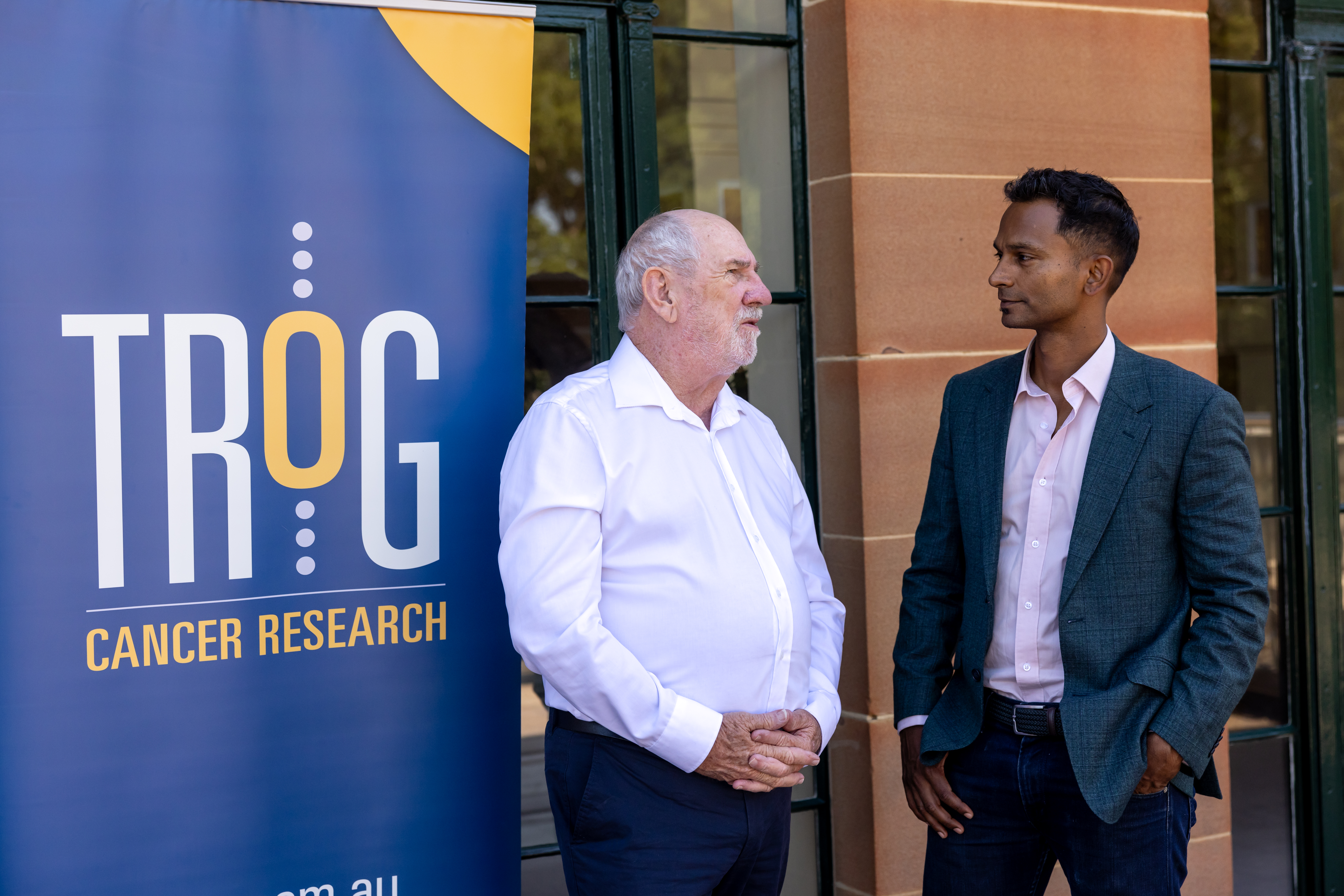
Pictured above: FASTRACK II Chief Investigator Prof Shankar Siva with trial participant Charlie Sanders. Read Charlie’s story.
- Read the paper on the FASTRACK II long-term outcomes and the FASTRACK trials pooled analysis.
- Read more about the TROG 15.03/ANZUP 16001 – FASTRACK II trial.
Related Post
TROG 08.03 RAVES sub-study sheds light on quality of life after post-prostatectomy radiotherapy
LATEST NEWS: 16 July 2026 Secondary analysis of data
TROG 18.01 NINJA prostate cancer trial completes recruitment
LATEST NEWS: 15 July 2026 The TROG 18.01 NINJA