
LATEST NEWS: 14 October 2026
Adding a FET-PET brain scan to standard magnetic resonance imaging (MRI) scans could help with planning targeted radiation therapy after surgery in adult patients with newly diagnosed glioblastoma, new TROG trial findings show.
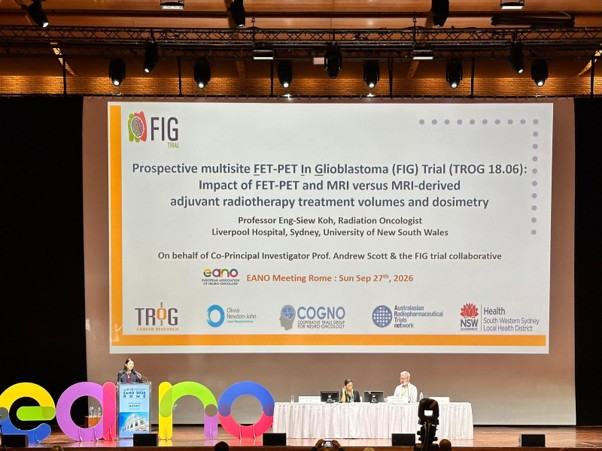
The promising findings from the FET-PET in Glioblastoma (FIG) – TROG 18.06 trial were presented at the European Association for Neuro-Oncology (EANO) conference in Rome, Italy, in September, and published in the journal Neuro-Oncology.
Glioblastoma is the most aggressive form of primary brain cancer, with around 1,000 cases diagnosed each year in Australia.
The findings from the FIG phase 2 trial involved adult patients with glioblastoma from 11 centres around Australia, who had undergone surgery and were due to have post-operative radiation therapy.
The study investigated how adding FET-PET imaging to standard MRI scans impacted the radiation gross tumour volume (GTV) delineation – a critical step in the process to define the area to be treated with radiation therapy. The study is also investigating the impact of FET-PET imaging in distinguishing pseudoprogression from true tumour progression or recurrence which will be reported at a later date.

The trial, co-led by Professor Eng-Siew Koh from Liverpool Hospital, NSW (pictured left) and Senior lead Professor Andrew Scott from the Olivia Newton-John Cancer Research Institute and Austin Health, Victoria, found that adding FET-PET to standard MRI scans when planning post-operative radiotherapy showed more clearly where the tumour may remain and how far it extended.
Among the 140 trial participants for whom FET-PET imaging data were available, adding FET-PET imaging would have changed radiation therapy planning in almost all participants.
The Hybrid-GTVs incorporating FET-PET with MRI have both a larger volume in 83% of cases, as well as being spatially distinct when compared to the routine MRI-derived gross target volumes. The lead researchers said the findings suggested that adding FET-PET to MRI scans in glioblastoma may help make treatment more effective by enabling better radiation therapy coverage and thus control of the brain cancer, which could lead to improved outcomes.
The study, which involved full central review of both nuclear medicine and radiation oncology derived volumes for radiation therapy, also highlighted the importance of FET-PET training and quality assurance, the researchers said.
“This is the largest multi-centre prospective study to evaluate the role of FET-PET in radiation treatment planning in newly diagnosed glioblastoma. The full impact of FET-PET incorporation into radiation treatment planning, dosimetry and correlation with patterns of relapse will be the subject of future analyses,” the authors wrote in Neuro-Oncology.
Congratulations to the research team on these important findings.

Listen to the Neuro-Oncology EANO Podcast interview with Prof Eng-Siew Koh about the results of the FIG study.
Read the paper in Neuro-Oncology on 24 September 2026.Listen to the Neuro-Oncology Podcast interview with Prof Eng-Siew Koh about the results of the FIG Study
Related Post
TROG trial of new lung cancer radiation therapy approach opens
LATEST NEWS: 17 September 2026 The first Australian site
TROG to run breast cancer trial in Australia after gaining $2.86m grant
LATEST NEWS: 29 July 2026 TROG Cancer Research is