

LATEST NEWS: 27 October 2026
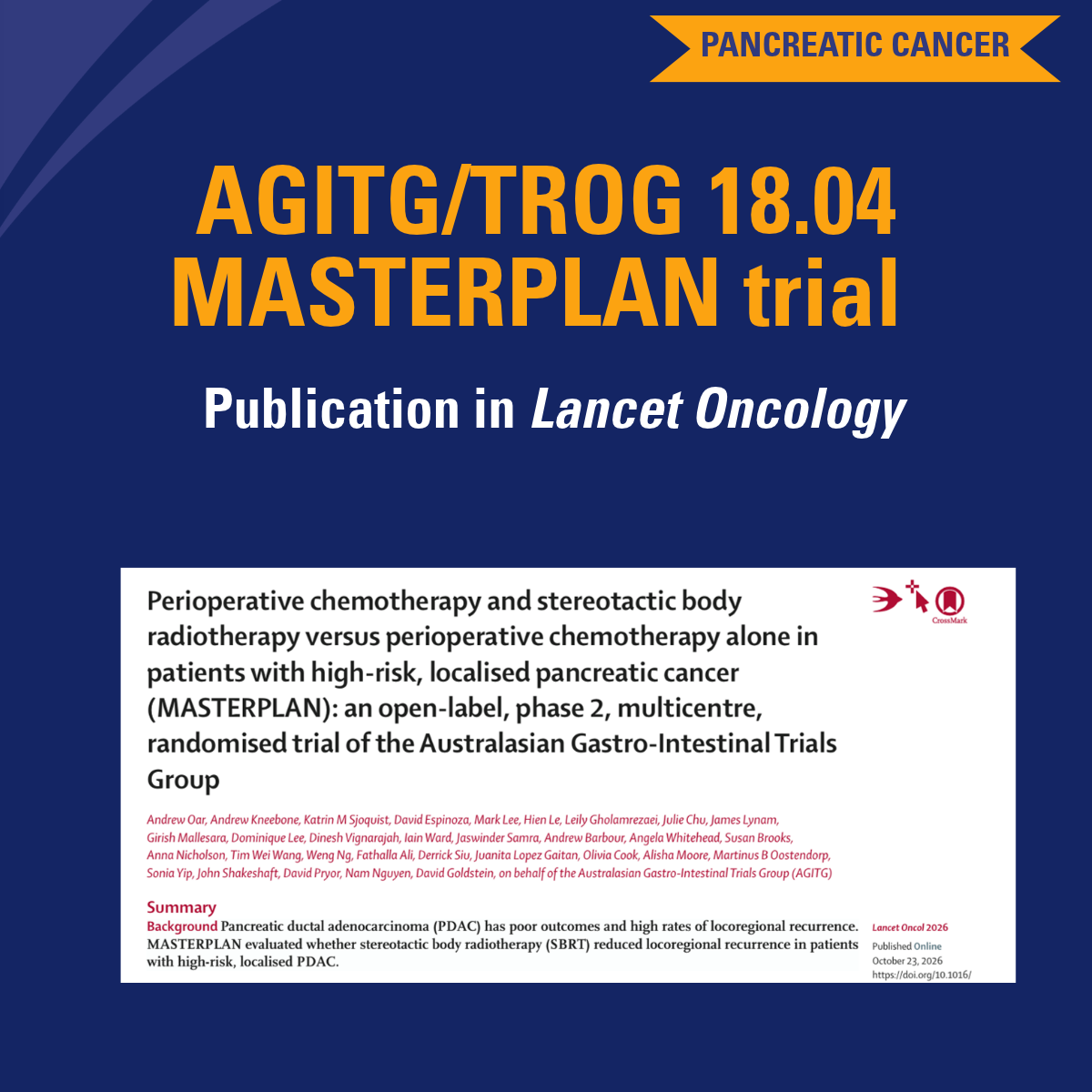
Findings from the AGITG/TROG 18.04 MASTERPLAN trial provide crucial new evidence that adding stereotactic body radiotherapy (SBRT) to chemotherapy is beneficial in patients with high-risk localised pancreatic cancer.
Results from the multicentre phase 2 study were simultaneously published in the Lancet Oncology journal and presented at the 2026 European Society for Medical Oncology (ESMO) Congress in Madrid, Spain this month.
Led by Dr Andrew Oar and Professor Andrew Kneebone, the MASTERPLAN study investigated whether adding perioperative SBRT to modern chemotherapy is superior to the current standard-of-care chemotherapy alone in patients with high-risk, localised pancreatic cancer. SBRT is a highly innovative treatment involving precision, targeted, high-dose radiation therapy.
The study was led by GI Cancer Trials (formerly the Australasian Gastro-Intestinal Trials Group) and coordinated by Sydney Clinical Trials Centre (formerly NHMRC Clinical Trials Centre), with TROG Cancer Research conducting radiation therapy quality assurance (RTQA).
The findings showed that 20% of participants who received SBRT as well as chemotherapy had locoregional recurrence – where the cancer returns in the same area – within 12 months, compared to 52% of participants who received chemotherapy alone.
With rigorous, real-time radiation therapy quality assurance, SBRT was shown to be safe, with a low incidence of Grade ≥3 toxicity.
The addition of SBRT nearly doubled progression-free survival, the length of time after treatment that a patient lives without the disease progressing or returning (11.9 months vs 6.3 months for chemotherapy alone). While there was longer overall survival in patients who received SBRT (22 months vs 14 months for chemotherapy alone), a larger study is needed to confirm this finding.
“With current treatments, we see that local progression is common and incredibly problematic. MASTERPLAN provides important evidence around the role of SBRT in pancreatic cancer. It’s very important evidence that has been lacking,” says Dr Oar.
Pancreatic cancer ‘silent’ symptoms
Pancreatic cancer is the third leading cause of cancer death in Australia, and the sixth globally. In Australia, pancreatic cancer has a five-year survival rate of 13%. Unfortunately, most cases are diagnosed at later stages, as early symptoms of disease are commonly ‘silent’ or ambiguous.
Of those diagnosed with pancreatic cancer, 1–2 in every 10 patients are estimated to have borderline resectable or locally advanced pancreatic cancer – tumours that are located very close to or partly wrapped around vital blood vessels, making surgery to remove them possible but technically challenging and uncertain. Current standard-of-care treatment for these patients involves preliminary delivery of chemotherapy, followed by re-evaluation of the cancer and, where appropriate, surgery. However, more treatment options are urgently needed.

“Further studies are still required to establish the exact role of SBRT and to confirm these findings, including its benefit on quality of life and survival endpoints,” says Dr Oar (pictured left). “MASTERPLAN was a significant step towards a greater understanding of that role.”
Between March 2019 and January 2025, 74 patients were randomised in the MASTERPLAN trial from14 sites across Australia and Aotearoa New Zealand, involving considerable multidisciplinary collaboration.
“There are so many people who contributed so much,” says Dr Oar.
“We thank every patient who took part in MASTERPLAN for contributing to this important research. I was also very proud of the multidisciplinary contributions, including allied health, towards MASTERPLAN, in addition to contributions from regional centres and New Zealand.
“I have been the beneficiary of some great mentorship throughout, including from GI Cancer Trials, Sydney Clinical Trials Centre, and the Trans Tasman Radiation Oncology Group – all of whom were instrumental.”
Importance of RTQA
TROG Head of Operations – Research and Quality Assurance, Alisha Moore, a co-author on the MASTERPLAN paper, said:
“MASTERPLAN highlights the importance of rigorous radiation therapy quality assurance in trials involving complex treatments such as SBRT. Through site credentialing and prospective treatment plan review, RTQA supports consistent, protocol-compliant treatment delivery and patient safety, providing greater confidence in the reliability of trial findings.
“This has been an incredible collaborative effort, and congratulations to everyone involved.”
- Read the Lancet Oncology paper
- Read the GI Cancer Media Release about the MASTERPLAN findings
Related Post
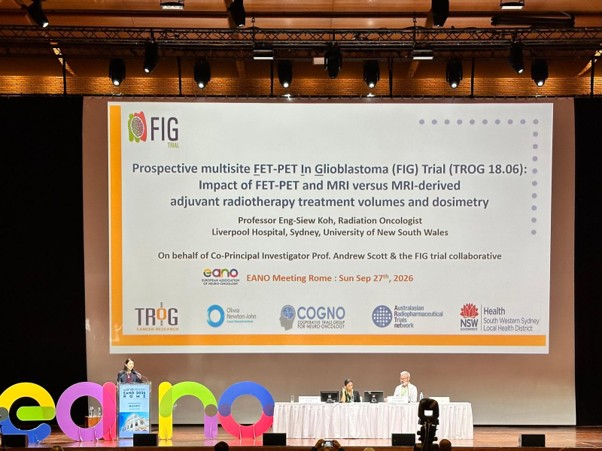
New FET-PET imaging approach helps target radiotherapy for glioblastoma, FIG trial – TROG 18.06 finds
LATEST NEWS: 14 October 2026 Adding a FET-PET brain
TROG 08.03 RAVES sub-study sheds light on quality of life after post-prostatectomy radiotherapy
LATEST NEWS: 16 July 2026 Secondary analysis of data